

How Much To Perform Dryrot Repair On Six Condos
Inspections Required. Beginning January 1, 2022, condominium associations with buildings that have three or more units must inspect elevated load-bearing structures which are supported essentially past wood. (Civ. Code §5551(l).) The inspector must submit a study to the board providing the physical condition and remaining useful life of the structures and their associated waterproofing systems. The statute does not change who is responsible to maintain, repair or supplant balconies or other elevated structures. It imposes inspection and repair obligations on HOAs as to balconies and/or elevated structures which associations are already obligated to maintain, repair or replace.
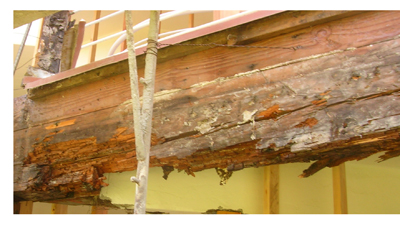 Dry out Rot Defined. The term "dry rot" is a misnomer. Woods does not rot when information technology is dry out. For decay to occur, moisture must be nowadays for fungi to feed on wood. Similar viruses and leaner, fungal spores are microscopic and travel through the air. The spores act as seeds which abound when they state on moist wood products. When they establish themselves into wood, they feed on the woods's cellulose. Cellulose is what gives woods its force. As the fungi eat cellulose, the wood weakens. Without wet, fungi cannot grow. Thus, the importance of keeping all waterproofing systems well-maintained. That is why the Davis-Stirling Deed requires a thorough inspection of waterproofing components such every bit flashings, membranes, coatings, and sealants. (Civ. Code 5551(a)(one).)
Repairs. Fungi (similar termites) spread throughout a construction as they feed on wood. As a upshot, dry rot tin be hard to treat. To stop the devastation, all decayed wood and fungi must be removed. The longer it goes untreated, the weaker the forest becomes until it collapses without alert. See: Balcony Maintenance & Repairs
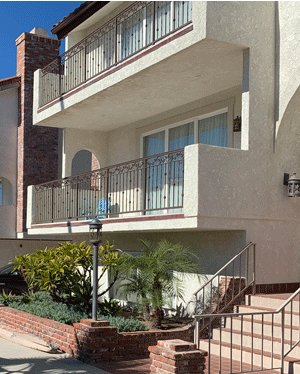 | 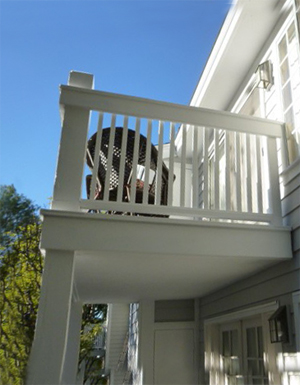 |
| #1 Cantilevered Balconies | #2 Balcony on Posts |
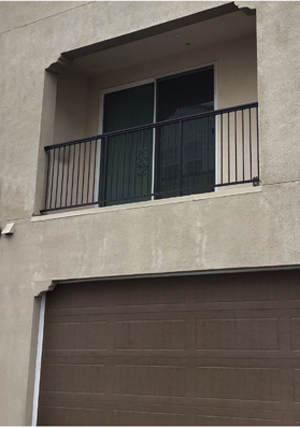 | 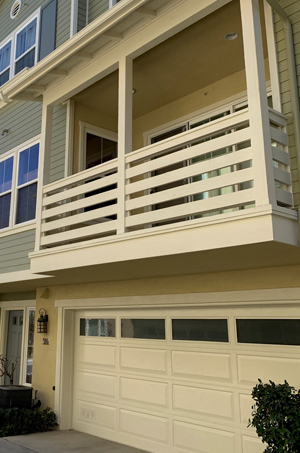 |
| #3 Balustrade over Garage | #4 Balcony over Garage |
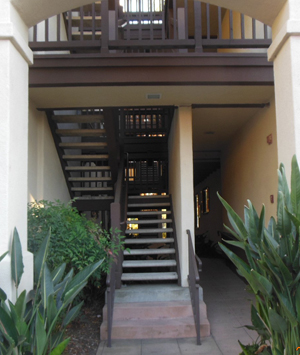 | 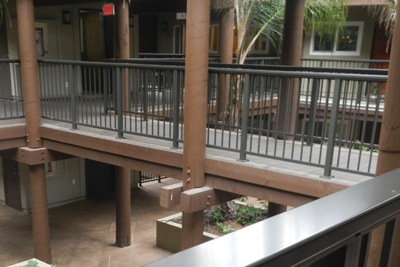 |
| #5 Stairs & Landings | #6 Elevated Walkways |
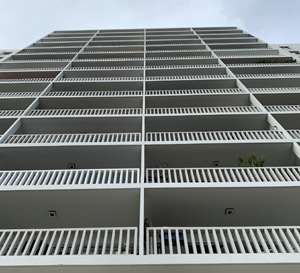 #7 Highrise Concrete Balconies | |
Elevated Structures Defined. Required inspections employ to load-begetting components and associated waterproofing systems. "Load-bearing" means (i) those components that extend beyond the exterior walls of the building to deliver structural loads to the edifice from decks, balconies, stairways, walkways, and their railings, (ii) that have a walking surface more than half-dozen feet above basis level, (3) that are designed for human occupancy or apply, and (iv) are supported in whole or in substantial part by wood or wood-based products. (Civ. Code §5551(a)(3).)
Illustrations . On the correct side of the screen are examples of different configurations of elevated structures needing inspection.
#1. Cantilevered balconies synthetic of forest must be inspected.
#two. Balconies supported past wood posts require inspection.
#three. Balconies supported by the chief construction do not require inspection since they cannot collapse. Balustrade railings, however, tin can requite way and should be inspected.
#4. Balconies partly supported by the structure and partly cantilevered require inspection.
#5. Exterior stairs and landings attached to woods require inspection.
#half dozen. Elevated walkways supported past wood structures must be inspected.
#7. Balconies made entirely of concrete and steel practise not require inspection.
Note : Elevated structures that practise not require inspection nether Civil Code §5551 still crave a diligent visual inspection for purposes of an association'south iii-yr cycle of inspections for their reserve study. This includes physical balconies.
Townhouse Balconies. A townhouse is a form of construction, not a class of ownership. A townhouse can be divers as a condominium or a separate interest in a planned development. If the townhouse is a condominium, responsibility for balconies will depend on how a condominium unit is divers. If the unit of measurement'due south boundaries are the unfinished surfaces of the interior walls, ceilings and floors, the townhouse structure is owned in common by the membership. That makes the clan responsible for repair and replacement of the structure, unless the CC&Rs clearly state otherwise. (Civ. Code §4775.) If a unit's boundaries are divers every bit extending to the exterior surfaces of the townhouse, the structure becomes part of the unit and is the responsibility of the homeowner unless the governing documents land otherwise. NOTE: Boards should have their documents reviewed by legal counsel.
If townhouses are defined as a planned development, homeowners own the structure and the lot upon which it was built. That means homeowners are responsible for their own balconies. The balustrade beak does not apply to planned developments, only to condominiums.
Deadline for Inspections. Associations must consummate their first inspection before January 1, 2025. Thereafter, elevated structures must be inspected at least once every ix years. (Civ. Lawmaking §5551(b)(ane).)
Architect/Engineer and Reserve Analyst. The inspections must be conducted by a licensed structural engineer or architect. (Civ. Lawmaking §5551(b)(ane).) The inspector must inspect sufficient number of units inspected to provide 95 per centum conviction that the results from the sample are reflective of the whole, with a margin of error of no greater than plus or minus 5 percent. (Civ. Code §5551(a)(iv).) The clan'south reserve study professional should be notified when the inspection occurs since the result could bear on the toll allocations for detail line items in the study. Below is a list of inspection companies readers sent to usa. Boards should have legal counsel review any proposed contracts.
Borescopes. Inspectors are allowed to use the to the lowest degree intrusive method necessary to examine load-bearing components, including visual observation in conjunction with moisture meters, borescopes, and infrared engineering. (Civ. Lawmaking §5551(a)(5).) The advantage of a borescope is that only small holes are drilled into the stucco, which are hands patched. Yet, information technology is sometimes difficult for the scope to see signs of h2o infiltration and deterioration of the framing. Oftentimes, the meliorate arroyo is to open the underside of balconies so an inspector can easily see the structural elements. Some inspectors utilize both inspection methods, depending on the particular projection and the condition of the structures.
Inspection Costs. To achieve the 95% confidence level required past the bill will exist expensive. It is estimated that nigh associations should wait costs in the range of $v,000 to $20,000. The total cost will depend on the number of elevated structures inspected to achieve the high confidence level required past the bill.
Using Reserves. Because inspections are directly related to reserves needed to repair elevated structures and because the definition of "replacement price" includes related expenses, inspection costs can be included in an association's reserve upkeep. Using reserves for such purposes would non be deemed a borrowing.
Inspector's Report. The inspector must submit a report to the board of directors specifying the current physical condition and remaining useful life of the load-bearing components and associated waterproofing systems. The report must be submitted to the board immediately upon completion of the study, and to the local code enforcement agency within 15 days of completion of the written report. (Civ. Code §5551(due east).) The inspector'south reports must exist kept by the clan for at least two inspection cycles. (Civ. Lawmaking §5551(i).)
Safe Measures. If the inspector advises that the outside elevated element poses an immediate threat to the prophylactic of the occupants, the association must have preventive measures immediately upon receiving the report, including preventing occupant admission to the exterior elevated chemical element until repairs take been inspected and approved past the local enforcement agency. (Civ. Code §5551(chiliad).)
Contracting for Inspections and Repairs. Contracts prepared by vendors can sometimes be skewed to protect the vendor. This is normal only not particularly benign to the association. Earlier signing whatever contracts, boards should make sure legal counsel reviews them.
Inspection Companies. Beneath is a list of companies that perform inspections of elevated structures. The data was sent to us by readers of our newsletter and should non be construed every bit our endorsement of the performance of any of the companies listed below. Earlier hiring a company, boards must perform their due diligence and make certain the company is licensed and insured. In improver, boards should take legal counsel review all contracts earlier signing them.
| A7 Group, Inc. 700 2nd St, Unit H Encinitas, CA 92024 (760) 945-3700 Adam Rohrbaugh [email protected] www.a7architect.com | A.D. Magellan | AWS Consultants 2030 E quaternary St, #208D Santa Ana, CA 92705 (714) 835-2301 Carl Brown [email protected] www.awsconsultants.com | Axis Consultants |
| B2R Consulting Group | Bergeman Grouping Const. Mgmt 11099 La Cienega Blvd, #175 Los Angeles, CA 90045 Randy Beery (619) 599-6216 [email protected] www.bergemangroup.com | CL Sigler & Assoc., Inc. | Design Build Associates 5655 Lindero Canyon Rd, #321 Westlake Village, CA 91362 (818) 889-0402 Dennis Brooks [email protected] www.dbuild.com |
| Focused Inspection Group 1999 S. Bascom Ave, #700, Campbell 95008 333 Urban center Blvd West, #1700 Orange, CA 92868 Alex Riley [email protected] www.focusedinspections.com | Pacific InterWest | Rupert Construction Services | Southern Cross Consultants 4045 Hancock St, #240 San Diego, CA 92110 (858) 395-8657 Matthew Boomhower, AIA [email protected] www.SouthernCrossPC.com |
| Sullivan Construction Mgmt P.O. Box 2387 Alpine, CA 91903-2387 (619) 722-7580 Pat Sullivan [e-mail protected] www.sullivancm.com | Van Sande Consultants 2920 De la Vina Street Santa Barbara 93105 805-963-6901 Carolle Van Sande, CSM [e-mail protected] www.vansandestructural.com |
Acknowledgement. Thank you to Dennis Brooks of Design Build Associates for photos of balconies and to Nib Leys of DeckExpert.com for his photo of dry rot in a balcony beam.
Stock Co-ops & Customs Apartments. Stock cooperatives and customs apartment are both forms of common interest developments governed by the Davis-Stirling Human activity. Ceremonious Code §5551(l) states that inspections of elevated wooden structures apply to multi-family structures with 3 or more than units. This would seem to apply to stock co-ops and customs apartment projects. However, the statute also states, "At least once every nine years, the board of an clan of a condominium project shall cause a reasonably competent and diligent visual inspection to exist conducted..." (Civ. Code §5551(b)(1).)
That linguistic communication appears to let these two forms of common involvement developments off the hook even though they own and are responsible for maintaining and repairing balconies and other elevated wooden structures. The statute'southward clear intent is to increase the safety of residents in associations with elevated wooden structures. Accordingly, stock co-ops and community flat projects should voluntarily follow the statute'due south requirements to inspect and repair all elevated wooden structures. Doing so protects residents and minimizes any potential for lawsuits.
Recommendation . Because of the bibelot in the statute, stock cooperatives and community flat projects with multi-family structures with three or more units should get a written legal stance from legal counsel on how best to go on. Clearly, the safer class of action is to audit and repair elevated structures. Doing so protects residents and minimizes whatever potential for litigation and judgments against the association.
Assistance : Associations needing legal help tin contact us. To stay current with bug affecting community associations, subscribe to the Davis-Stirling Newsletter.


How Much To Perform Dryrot Repair On Six Condos,
Source: https://www.davis-stirling.com/HOME/E/Elevated-Structure-Balcony-Inspections
Posted by: swearingendishice.blogspot.com
0 Response to "How Much To Perform Dryrot Repair On Six Condos"
Post a Comment